The Software Development Life Cycle
How Teams Build Software from Idea to Deployment
I've worked on projects where there was no clear process, and the chaos is memorable. Features get built before anyone agrees on requirements. Testing happens as an afterthought. Deployments become fire drills. The Software Development Life Cycle exists to prevent exactly this kind of mess.
The SDLC is a structured approach to building software that breaks the work into distinct phases. Each phase has a purpose, produces specific deliverables, and sets up the next phase for success. Understanding how these phases connect has helped me see where my work fits in the bigger picture.
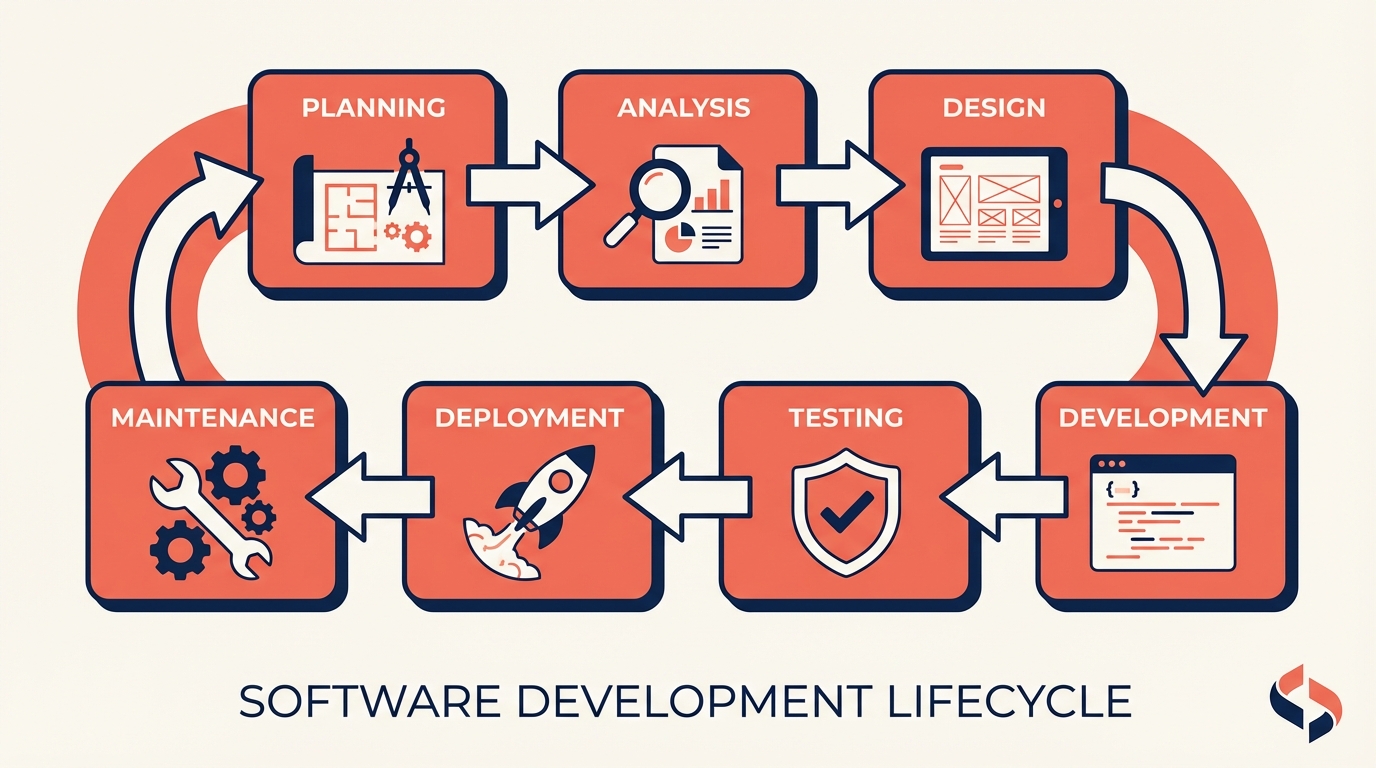
Planning kicks everything off. Project managers, stakeholders, and senior developers get in a room and figure out what they're building, who's building it, and how long it should take. The output is a project plan, a scope document, and a resource allocation plan. This is where you prevent scope creep before it starts, by getting everyone aligned on what's in and what's out.
Analysis digs deeper into the requirements. Business analysts work with stakeholders and technical leads to translate business needs into specific features. The key deliverable is a requirements specification document, sometimes called an SRS. A good requirements doc becomes the contract between stakeholders and the development team. This phase also produces a risk analysis report that identifies potential problems before they derail the project.
Design turns requirements into a technical blueprint. System architects and designers figure out the software's architecture, data models, and user interfaces. These design documents guide developers during implementation. Skip this phase and you end up with a patchwork of code that nobody can maintain.
Development is where code actually gets written. Developers use the design documents as a reference to build the source code, database schema, and application components. The best development work follows directly from the specifications laid out in design. When developers have to guess at requirements, things go sideways fast.
Testing happens before users ever see the software. QA engineers run through test cases to verify the software works as intended. They log bugs, track them to resolution, and produce test summary reports. Thorough testing catches issues when they're cheap to fix, not after they've caused problems in production.
Deployment is the rollout. System administrators and deployment engineers push the software to production. Depending on the risk profile, this might be a gradual release to a subset of users before a broader launch. The deliverables include deployment scripts, the deployed software itself, and user documentation.
Maintenance never really ends. Once software is live, support teams monitor it, fix bugs, roll out updates, and introduce enhancements. Patch updates, resolved support tickets, and updated documentation are the ongoing outputs. Most software spends the majority of its life in this phase.
Methodologies Shape the Process
Different teams apply these phases in different ways. The two most common approaches I've encountered are Waterfall and Agile.
Waterfall follows the phases sequentially. You complete planning before starting analysis, analysis before design, and so on. This works well when requirements are well-defined upfront and unlikely to change. Government contracts and safety-critical systems often use Waterfall because the documentation and predictability matter more than speed.
Agile takes an iterative approach. Instead of moving through all seven phases once, teams cycle through them repeatedly in short iterations. Requirements evolve through continuous collaboration with stakeholders. If something isn't working, you find out in weeks rather than months. Agile frameworks like Scrum and Kanban provide specific practices for managing this iterative flow, from sprint planning to visual task boards.
Neither approach is universally better. The choice depends on your project's constraints, your team's experience, and how much uncertainty you're dealing with.
Why This Matters
Understanding the SDLC helps us see beyond our immediate tasks. When you're debugging code, you're in the maintenance phase of something that started as a planning discussion months earlier. When you're writing requirements, you're creating the foundation that developers will build on. Each phase connects to every other.
The teams that ship quality software consistently aren't necessarily more talented. They just have a process that prevents the common failure modes: building the wrong thing, building it poorly, or releasing it before it's ready. The SDLC is that process, and knowing how it works makes you a more effective contributor at every phase.