Data Warehouses
Turning Historical Data into Business Insights
In the previous post, I looked at transactional databases that power real-time operations. But I've learned the hard way that running complex analytical queries against production databases is a bad idea. It slows down the application and puts operational data at risk. Data warehouses solve this by providing a separate system optimized for analysis rather than transactions.
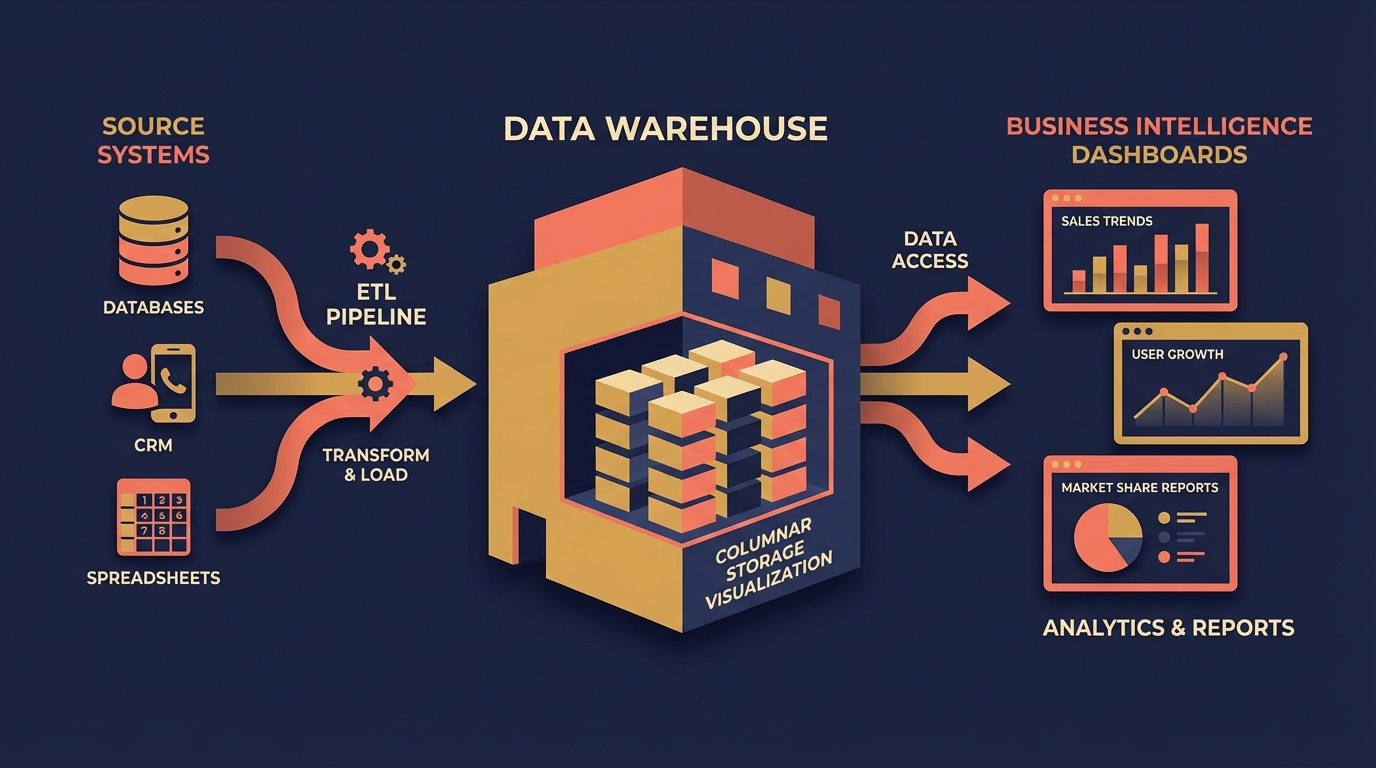
A data warehouse, also called an Online Analytical Processing (OLAP) system, aggregates data from multiple sources into a single repository designed for complex queries. Instead of optimizing for fast writes and consistent reads, data warehouses optimize for read-heavy analytical workloads. They store historical data spanning months or years, enabling trend analysis, forecasting, and business intelligence reporting.
How Data Gets There
The defining workflow of a data warehouse is ETL: Extract, Transform, Load. Data is extracted from transactional databases, CRMs, and other source systems. It's then transformed into a consistent format, cleaning up inconsistencies, applying business rules, and restructuring for analysis. Finally, it's loaded into the warehouse. This process typically runs on a schedule, whether hourly, daily, or weekly, depending on how fresh the data needs to be.
Data warehouses use a schema-on-write approach, meaning the structure is defined before data is loaded. This upfront work ensures consistency and enables the query optimizer to work efficiently. The tradeoff is less flexibility: if your analytical needs change, you might need to rebuild parts of the warehouse.
Columnar Storage
One thing that clicked for me was understanding why most data warehouses use columnar storage rather than row-based storage. Instead of storing entire records together, they store each column separately. This matters for analytics because queries typically access only a few columns from tables with many columns. Columnar storage lets the database read just the relevant columns, dramatically speeding up aggregations and filtering operations. It also compresses better since similar values are stored together.
Use Cases
Data warehouses power business intelligence dashboards that show executives sales trends, client behavior, and operational metrics. They enable historical analysis, letting analysts ask questions like "How did last quarter compare to the same period last year?" They support data mining, where patterns emerge from large datasets that wouldn't be visible in day-to-day operations.
The limitation is latency. Because data flows through ETL pipelines, the warehouse is always somewhat behind real-time. For businesses that need immediate insights, this delay can be a problem. Additionally, data warehouses work best with structured data. If you're dealing with logs, images, or other unstructured data, you'll need a different approach.
In the next post, we'll explore data lakes, which handle unstructured data, and I'll share how I think about choosing the right storage system for different needs.